


Views: 66 Author: Lucian Publish Time: 2026-10-20 Origin: Site


AUKE · EMPTY BASKET RETURN
Less return space is useful only if the next basket comes out easily. Find what is touching before changing the design.
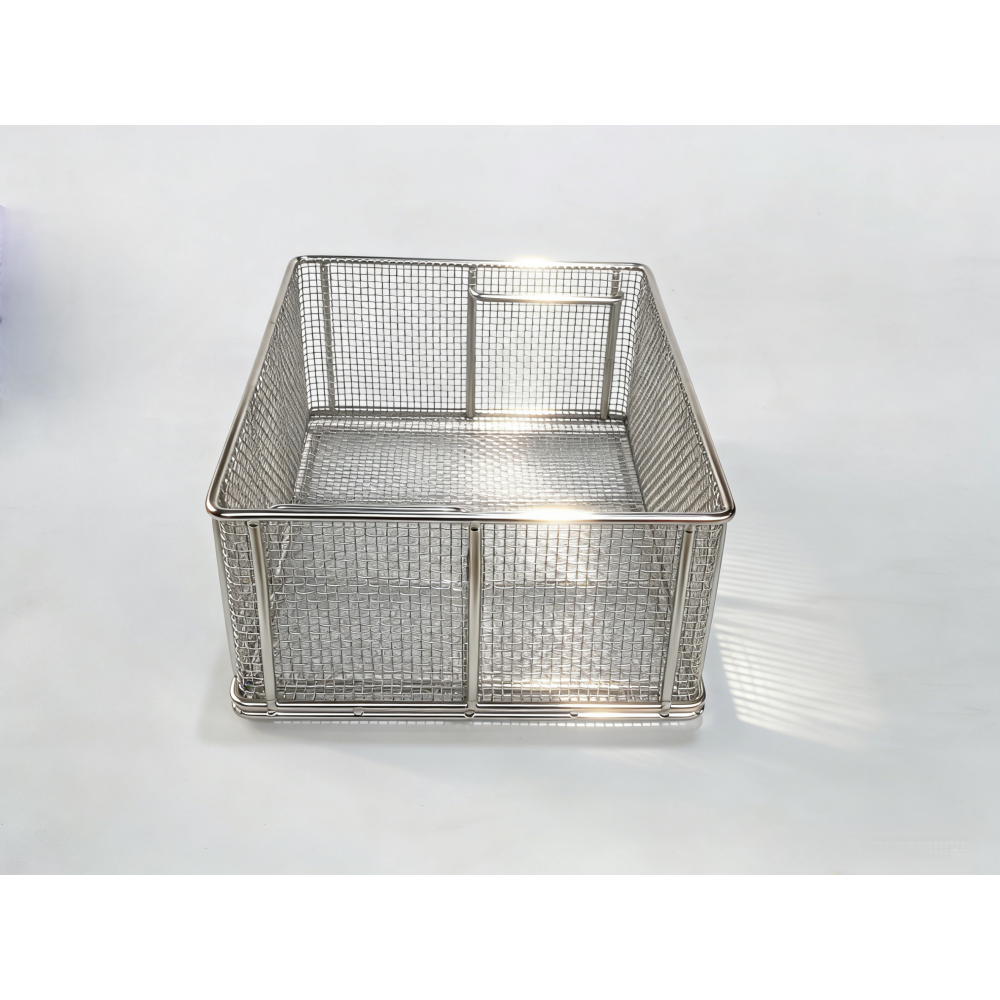
A trolley arrives with empty baskets ready for another batch, but the first basket will not lift free. For a purchasing manager, that delay belongs in the comparison alongside return-space savings. A compact bundle is not a useful improvement if operators must separate it before loading can restart.
Choose nesting wire mesh baskets when they seat at a controlled depth and separate reliably in the actual return routine. If a fixed insert, handle or straight-sided frame prevents clear movement, supported stacking may be the simpler choice. The photographs here illustrate structures to inspect, not a proven nesting arrangement.
Nesting means one empty basket enters another. Stacking means the upper basket rests on defined supports instead of sinking deeply into the basket below. A design may allow both, but only with the correct orientation or support position.
The wire mesh basket must hold parts during use; its empty-return arrangement must not compromise those supports or the machine interface. Ask whether inserts, lids or movable supports remain in place on the return trip. A nesting demonstration with those items removed may not represent your daily work.
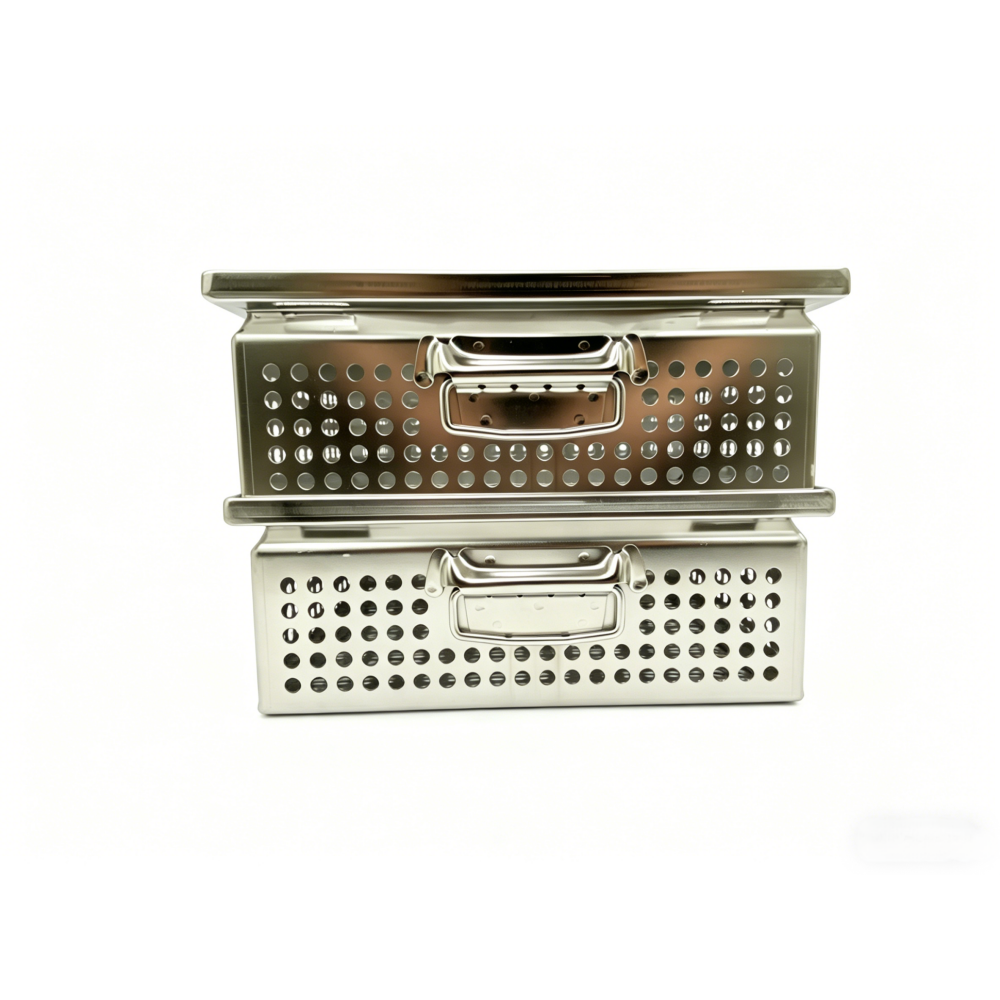
Compare the arrangement you will actually use. These AUKE perforated baskets are shown stacked, with the basket bodies remaining above one another. This photograph illustrates the alternative to deep nesting; it does not establish a permitted stack height or load.
Observe the normal handling movement on a stable surface with empty, cool baskets. Stop if separation requires excessive force or lifts an unintended basket; do not pry them apart or put fingers between trapped rims. Record the sticking location before trying a different basket pair.
With tapered walls, greater insertion brings the sides closer together. If the walls become the stopping surfaces, pressure from baskets above can make separation harder. A controlled nesting stop is worth investigating when the sticking follows depth rather than one visible hook.
Look for a handle, latch, wire end or base rail crossing the other basket rim. A stop may keep the upper basket above that obstruction, but a local change to the protruding feature may preserve more return-space savings.
Mark the basket identities and compare another pair. If the problem follows one basket, check frame distortion, weld projections or damage before changing every basket. If it follows a mixed model combination, the issue may be compatibility rather than manufacturing quality.
A proposed stop should arrest insertion before the walls wedge or the frame catches a handle. Its contact location matters: supporting an upper basket on a thin mesh panel can deform that panel and change the seating depth. The intended contact should be supported by a suitable structural member.
A higher stop usually leaves more clearance but adds height to the returned bundle. More wall taper can aid insertion, but may reduce usable floor area within the same top opening. Neither change should be approved without checking the existing part arrangement and equipment fit.
Keep the stop accessible for cleaning and allow room to grip the basket. Do not add a coating or lubricant merely to make a tight pair slide; process compatibility and dimensional clearance still need to be established.
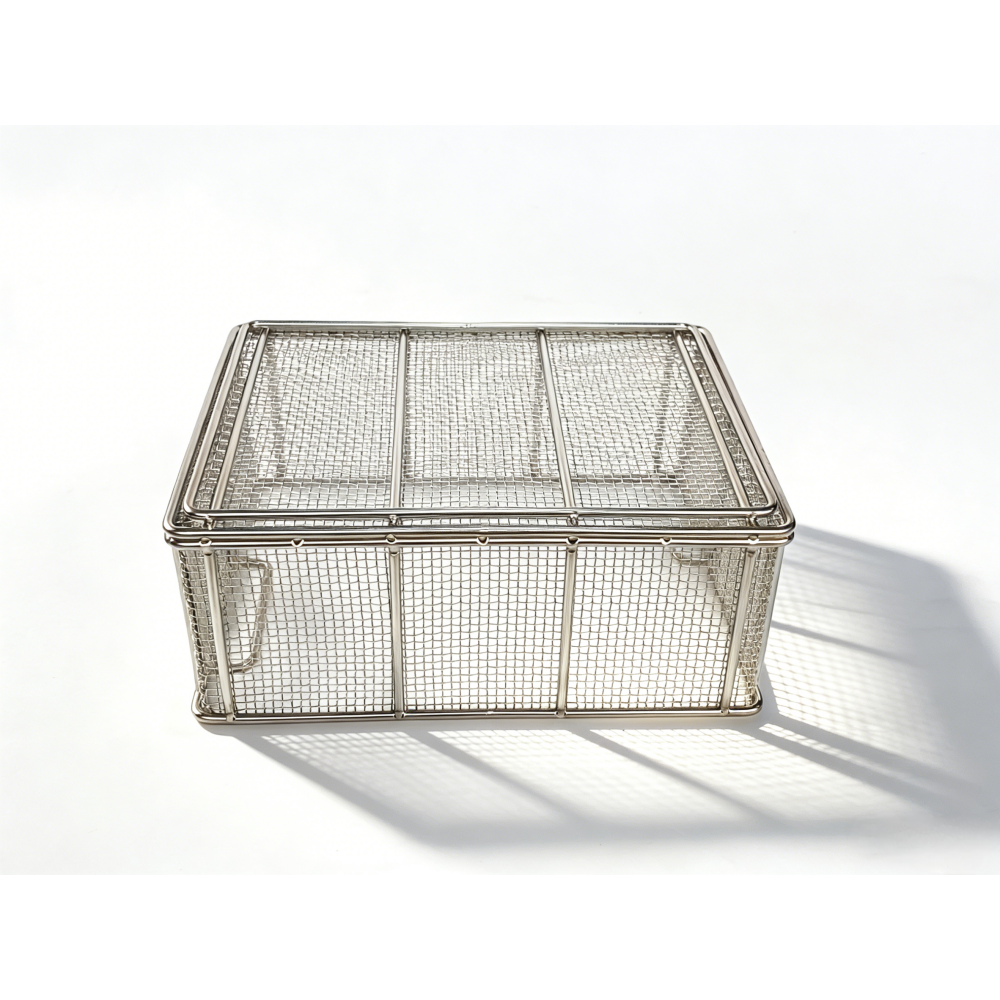
The underside view exposes base rails that must clear the receiving rim; their visible shape alone does not prove that two baskets can nest.
Two samples that fit together establish very little about a fleet of nesting wire mesh baskets. Finished frame width, wall taper, rim squareness and stop height all affect clearance. Welding distortion or a misplaced stop can make one basket enter farther on one side.
Agree which finished dimensions control the fit, then compare several identified basket combinations, including existing baskets if they will share the return route. Use the normal orientation, return quantity and handling method. Check again after representative handling and cleaning cycles, because a clean bench trial cannot show every service condition.
Record whether resistance changes after permitted cleaning of the contact area. Improvement suggests residue contributes; unchanged resistance keeps geometry or mechanical interference under consideration. Keep temperature and basket pairing comparable so a change in either does not obscure the cause.
Combination: basket IDs, orientation and items left inside.
Seating: insertion depth, first contact and any uneven rim gap.
Release: normal separation time, sticking location and any extra handling.
Condition: before or after the return trip, cleaning state and visible damage.
For a repeat order, retain the approved drawing revision and the functional trial conditions. If a basket fails the agreed fit, measure the frame and stop positions, correct the relevant fabrication deviation and repeat the affected combinations. Do not approve only the pair that happens to separate.
For equal basket quantities and comparable footprints, measure the total height in each return arrangement. Height reduction is (stacked height minus nested height) divided by stacked height. This is a height comparison, not automatically a floor-space or transport-cost saving.
Then record the extra seconds needed to separate each basket and how often that action occurs. Multiply extra seconds per basket by baskets handled per shift, then divide by 60 to obtain extra handling minutes. Use observed times, including recurrent sticking, rather than the fastest demonstration.
Keep nesting if the measured benefit remains worthwhile and handling is reliable. Choose supported stacking if required inserts block nesting or the release routine remains troublesome. A shallower nest can also be a reasonable compromise.
It may improve clearance, but it will not remove a handle or rail that catches the rim. Identify the contact first; changing taper may also reduce the usable base area.
Only if that contact is designed for the intended return arrangement. An incidental contact can deform mesh and alter seating; agree the support location and permitted return quantity.
Possibly, but matching nominal length and width is not enough. Compare actual rim, base, handle and stop dimensions, then trial mixed combinations before committing to replacement batches.
Send a side view of the nested pair and a close-up of the sticking area. Include the normal return quantity and whether all pairs or only some pairs stick.
Custom metal baskets for cleaning and handling
Rectangular wire mesh basket construction
Share a side view of the nested pair and a close-up of the sticking area with AUKE. We will compare the visible contact with your return arrangement and discuss whether a stop, a relocated protrusion or supported stacking deserves a sample trial. Photographs start the discussion; dimensions and physical trials determine the fit.
Email Your Basket PhotosBy AUKE Engineering Team


