


Views: 99 Author: Site Editor Publish Time: 2026-10-19 Origin: Site


AUKE CUSTOM METAL BASKETS
Square-edged parts need room at the corners. Choose the inside shape for part clearance, cleanable joints and drainage.
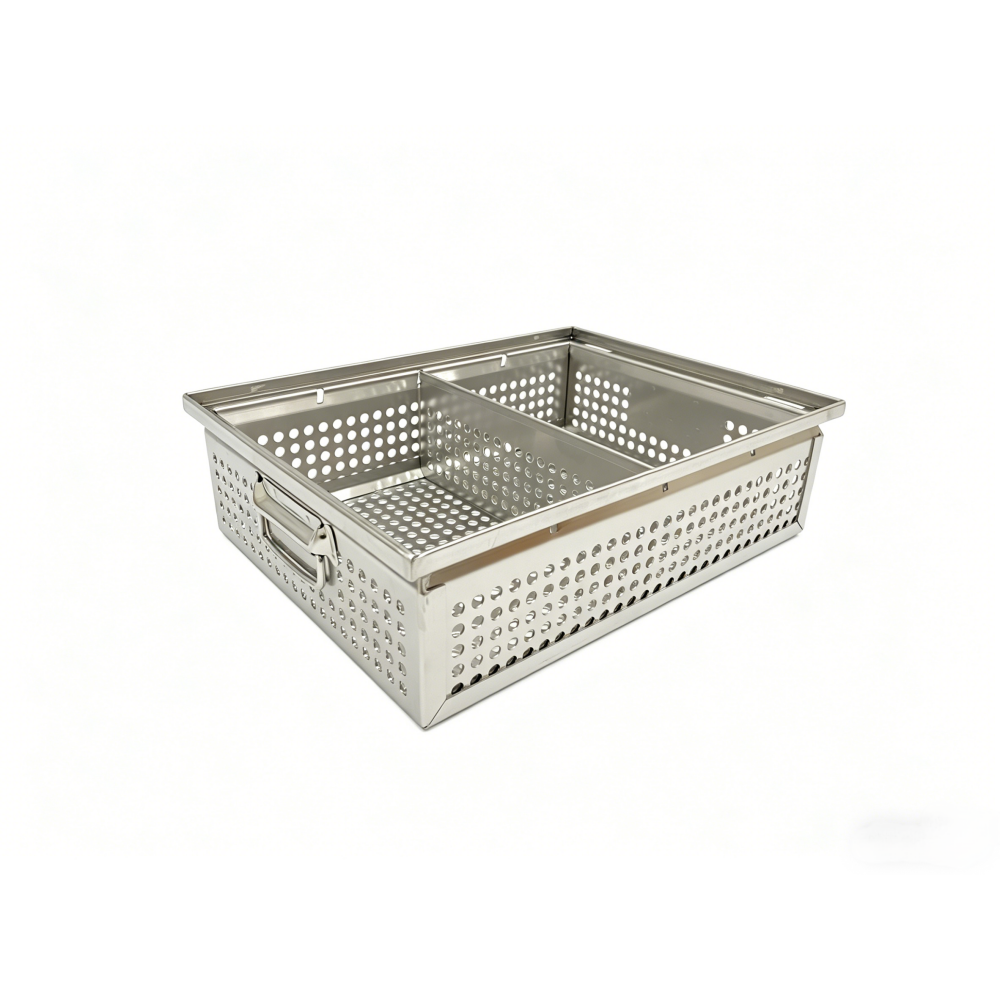
If a rectangular part or tray must sit close to the basket walls, start with a compact internal corner that leaves enough room for it to sit flat. If the parts sit well away from the walls and residue collects in a tight internal joint, a smooth curved transition may be the better starting point.
Those are different requirements, and the same basket can need both. Choosing a metal basket corner radius starts with the space the parts actually use, not a preference for a square or rounded appearance.
A rectangular part sits against the wall: protect the clearance around its lower edge.
The basket itself is hard to clean: examine the inside joint and any overlap that traps residue.
Small loose parts reach the corners: check the finished corner opening, not only the mesh size on the straight side.
Consider a square-edged tray lowered into a cleaning basket. Its width clears the straight walls, but its lower edge touches the curved bend where the floor meets the wall. The tray stops above the base instead of sitting on it.
A raised tray may prevent the lid closing or miss its intended supports. Moving it inward may solve the interference but reduce the space for other parts. Do not force it down.
Compare the part drawing with a section through the basket at the intended support position. The drawing needs to show the curved floor bend as well as the wall spacing. If an insert holds the tray above that bend, the same radius may cause no interference at all.
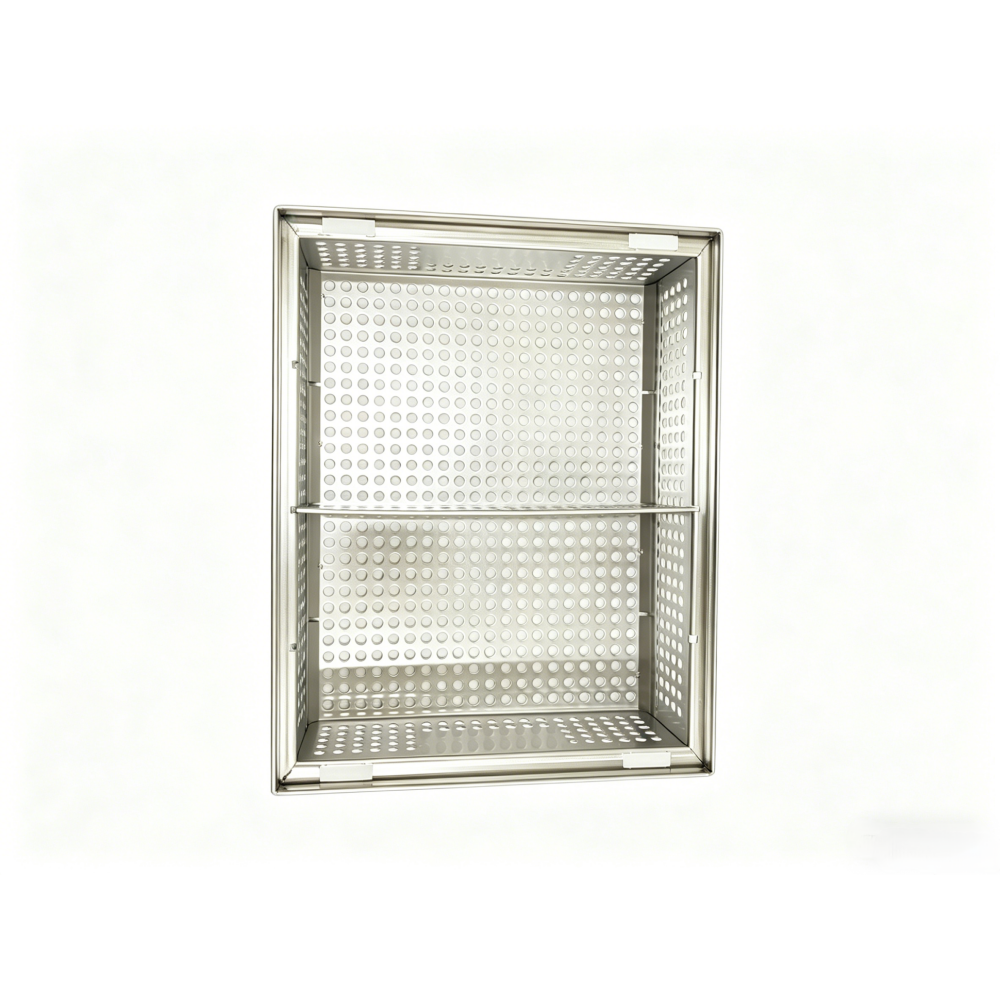
Follow the inside wall down to the floor: this is where a tray's lower edge needs clearance, even when its width fits between the walls.
A 90-degree angle describes the direction of two walls. A radius describes the curve joining them. Perpendicular walls can therefore have a rounded junction, and a drawing marked only "90 degrees" does not tell the manufacturer how much corner space the part needs.
There are also two different internal curves to consider: the wall-to-wall corner seen from above, and the floor-to-wall bend seen from the side. A larger inside curve can occupy space that a square-edged part needs. The external frame bend is a separate detail and cannot establish either clearance.
For a close-fitting tray, agree the minimum usable space at its seating height, including dimensional tolerances. Keep exposed edges smooth and free of burrs regardless of the chosen radius. A compact corner does not have to mean a sharp exposed edge.
For the basket itself, look at the joint between the floor and walls. An overlap with a narrow gap can hold residue even if the outer frame is rounded. A smooth internal transition may remove a difficult-to-reach junction, provided the proposed construction does not leave another crevice.
For the parts, the basket must hold them without blocking the surfaces that need cleaning. A tray pressed against a wall may shield a contact area from cleaning liquid; rounding a distant corner will not change that contact. The useful modification may be extra clearance or different supports instead.
Drainage is another requirement. Liquid needs an outlet at the low point in the actual drain position; a smooth but closed corner can still retain it. Choose a corner change to address an observed joint or obstruction, then compare cleaning and drainage in the customer process before claiming an improvement.
Before changing the radius, note whether the problem is a tray that sits too high, residue in the basket joint, or contamination on the part. These observations lead to different design changes. A photograph of the location is more useful than a general request for an easier-to-clean basket.
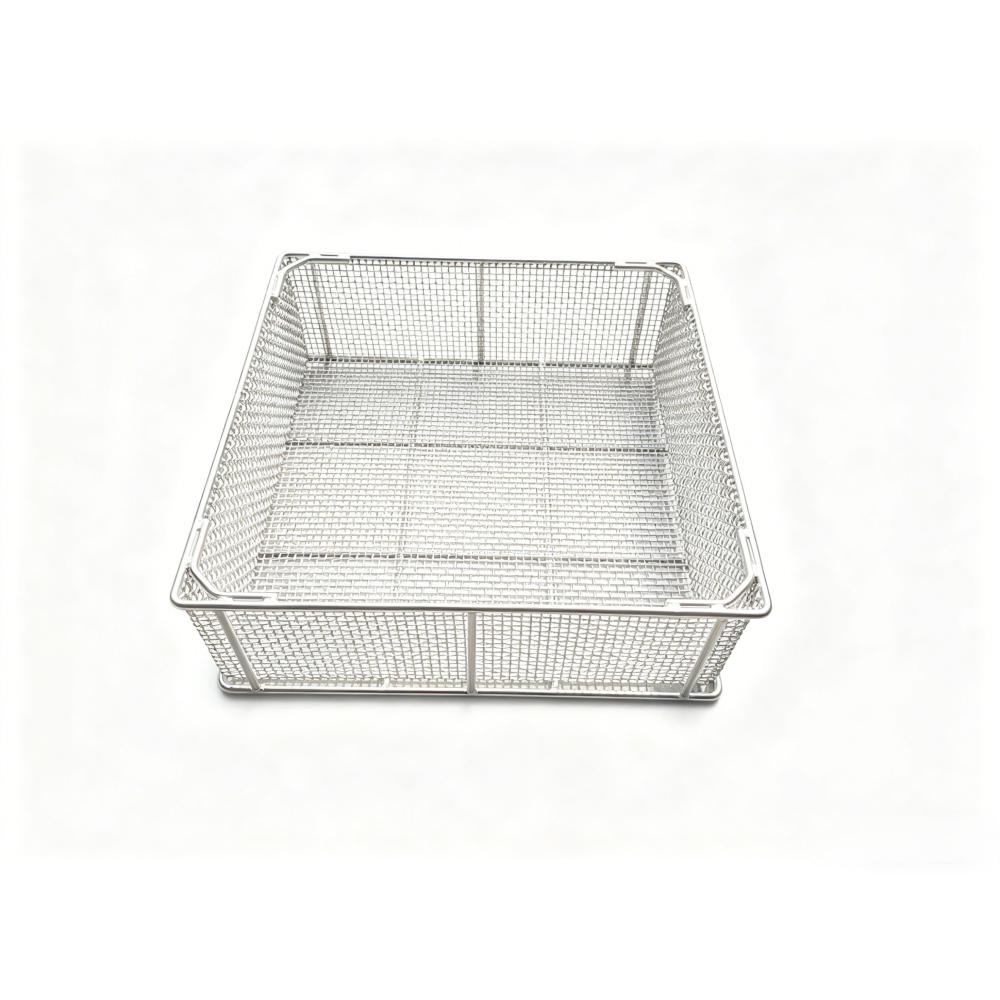
For small loose parts, a large usable rectangle may not be the main concern. Bending mesh or joining it to a frame can leave a corner opening different from the openings along a straight wall. Compare that finished opening with the smallest part in an orientation that could pass through it.
The mesh basket shown here illustrates where the mesh meets its frame. It is not a square-versus-rounded performance comparison: its construction differs from the perforated basket above.
A folded sheet corner has a practical bend radius determined by the material grade, thickness and forming method. Making that bend tighter can require a different manufacturing approach; it is not simply a drawing change. Holes near the bend also need enough surrounding material to withstand forming.
Joining separate panels can produce a different internal shape, but introduces a seam. Welding and finishing that seam add work, and the finished joint still needs to suit the cleaning requirement. Conversely, a larger radius may require more room inside the same outside dimensions.
This is why neither "square costs less" nor "rounded costs more" is a reliable purchasing rule. Compare the proposed construction and finishing, not just the corner label. For a wire basket, agree both the frame bend and the mesh attachment at the corner.
Part position: show where the part rests and the clearance it needs at that height.
Corner detail: identify the inside radius, relevant wall angle and finished joint.
Retention and drainage: define any critical corner opening and the intended liquid outlet.
Repeat orders: retain the approved drawing revision and a way to compare the finished corner with the agreed shape.
Try the sample with representative parts, including the largest permitted part dimensions where fit is critical. A tray that sits flat is evidence of fit, not proof of better cleaning. Any cleaning claim needs a trial under the intended operating conditions.
For repeat production, measure the agreed clearance after forming and welding, rather than relying on the bending tool setting alone. If it is outside tolerance, trace and correct the manufacturing deviation, then remeasure before release.
Only if the change addresses something that was obstructing cleaning. Removing a residue-trapping basket joint and exposing a covered part surface are different improvements; the trial must assess the one you need.
No. The wall angle, internal radius and exposed-edge finish are separate requirements. Square-sided baskets can still have smooth, deburred edges.
For close-fitting parts, start with the required usable space and the part position. Ask the manufacturer to propose a workable radius within those limits, rather than selecting an arbitrary radius first.
Confirm the corner construction, minimum usable space, joint finish and any critical opening. These details make offers comparable even when both suppliers describe the basket as square-cornered or rounded.
Custom wire basket configurations
Drainage without losing small parts
Share with AUKE a part outline and a photo showing how the parts sit in the basket. Tell us whether the concern is fit, residue or escaping parts. We will compare where clearance is needed and discuss whether to change the radius, joint or support position.
Before manufacture, the dimensions and tolerances need an agreed drawing. Cleaning performance must be confirmed in the intended process, not from photographs.
Discuss Your Basket CornersBy AUKE Engineering Team


