


Views: 115 Author: Lucian Publish Time: 2026-10-30 Origin: Site


AUKE / SUPPORT CONNECTIONS
Hidden dirt in support joints, worn contact points and unexpected basket downtime all start with this one design choice. Pick the right connection for your cleanliness standard and maintenance workflow.
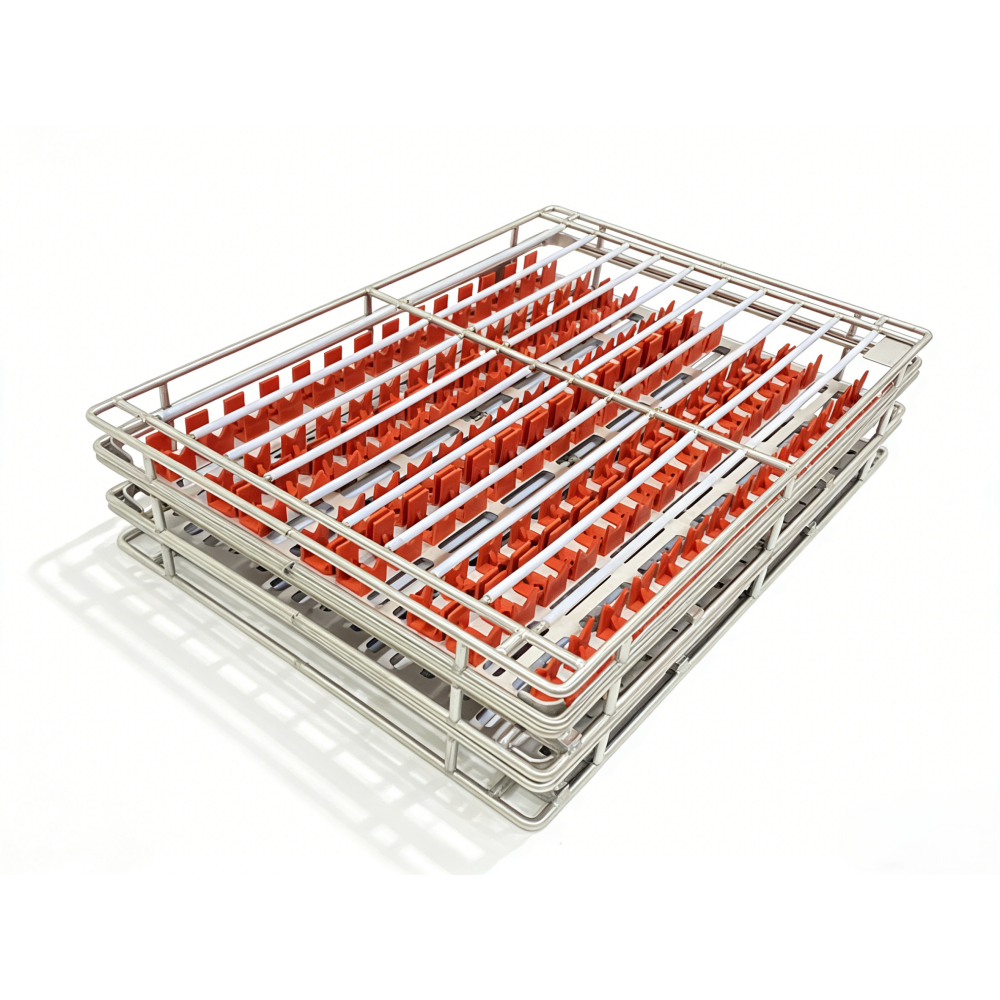
If you have ever found tiny particles on finished parts after cleaning, or had to retire an entire basket just because one support strip wore out, you already know why fixture connection style matters. For ultrasonic cleaning baskets, the way internal supports attach to the frame directly impacts your reject rate, maintenance work and total basket service life.
Welded supports work best when your part layout stays the same long-term and you want as few hidden gaps as possible. Removable supports make sense when contact pieces wear out regularly, or you need to swap fixtures for different parts. Removability only pays off, though, if supports lock back into the exact same position and stay secure through every cleaning cycle.
Imagine a precision machined part sitting on basket supports during ultrasonic cleaning. The support has two jobs: hold the part steady at the correct angle for full cleaning, and stay clean enough that it never becomes a source of contamination itself.
The second concern is repair. A permanently welded support that wears out may force you to scrap or rework the whole basket. A removable support sounds easier to fix — but loose fittings, hidden dirt under the base and misaligned reinstallation can create new quality problems.
This guide focuses only on the support-to-basket connection. We will not dive into ultrasonic generator settings, steel material grades or general welding defects. Ultrasound alone does not automatically loosen removable joints, and welding alone does not guarantee a clean, particle-free fixture.
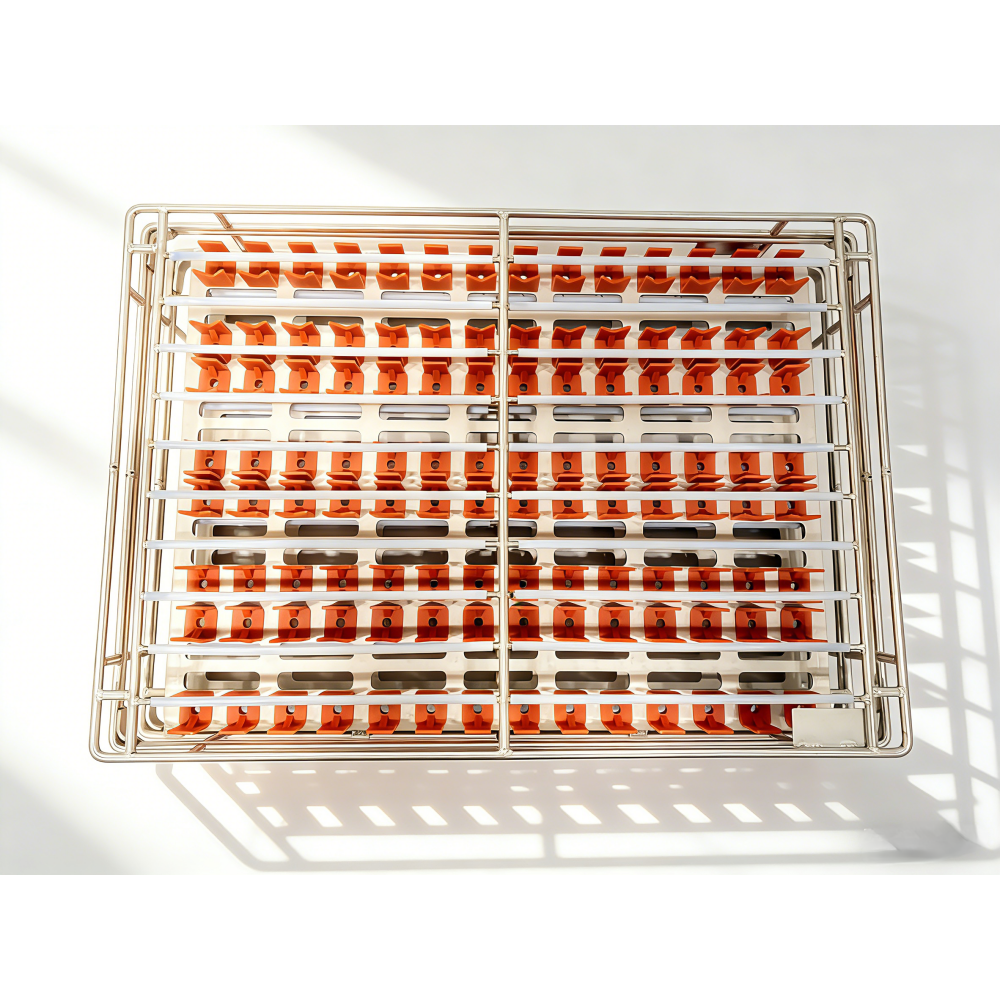
The upper support touches your parts; the metal strip underneath holds it in place. Dirt often collects where the two meet. Use this view to check for cleanable gaps and stable positioning — the photo shows construction, not a specific plastic material grade.
Before you redesign all your supports, confirm the root cause. Start from your actual quality standard: visible cleanliness, particle count limits or whatever pass/fail rule you use. Note where debris appears, whether the support has shifted, and whether fresh rub marks line up with support contact points. Contamination can just as easily come from incoming parts, the cleaning bath itself or downstream handling.
If you see polished wear marks plus loose fit, relative movement is likely the issue. If dirt collects under a support that never moves, restricted cleaning access is the more likely cause. Neither pattern alone proves that particles on the part came from that exact joint.
Run a side-by-side trial with your suspect fixture and a known good one, using the same parts, same loading pattern and same cleaning program. Compare joint condition and part cleanliness using your normal inspection method. If contamination stays the same on both, look at the bath chemistry, incoming parts and handling steps before you rework every basket support.
When you weld supports directly to the basket frame, you eliminate the gaps and crevices that come with screws, clips and removable seats. This is a big plus for cleanliness, especially in high-precision ultrasonic cleaning where even tiny trapped debris can ruin a batch. It also removes the risk of an operator refitting a support at the wrong angle.
Weld quality still matters. A support tack-welded onto a wide flat plate can leave a hard-to-clean sheltered gap underneath. “Welded” on a drawing tells you very little about actual cleanability. Good design places welds where they are accessible and avoids deep, enclosed overlaps that cleaning fluid cannot reach.
One tradeoff: welding heat can slightly shift support position. Always approve finished spacing and angles after welding, not just from the flat pre-assembly drawing. If you later need to cut out and replace a worn support, the repaired basket must pass full dimensional and cleanliness checks before going back into production.
What this means for you: lower contamination risk, fewer loose parts inside the bath, and less routine adjustment work — but less flexibility if you change parts later.
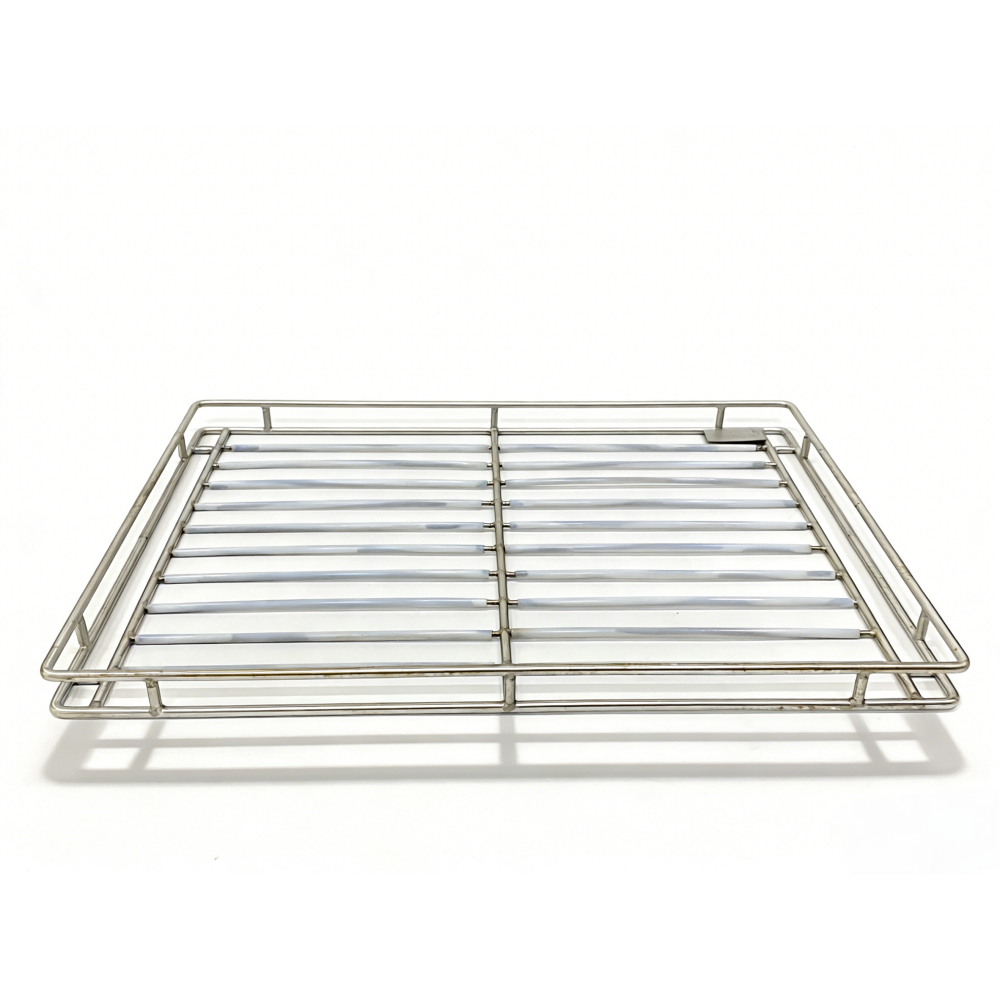
Rail ends and the center crossbar are the key spots to evaluate when planning support replacement. This tray illustrates a typical layout; it is not a performance comparison with the orange-support style.
Removable or clip-in supports let you swap out worn contact pieces while keeping the main basket frame in service. This can cut repair cost and downtime significantly, especially when soft polymer contact pieces are used to protect delicate part surfaces.
A good removable design does more than just screw on. It must locate the support accurately every time. Clamping screws alone cannot guarantee precise positioning if the mounting holes allow play. You also need to think about how the seating surfaces underneath get cleaned — loose bases are classic dirt traps.
A few ground rules: all fasteners must stay secure through vibration and handling — loose hardware falling into the cleaning bath is a serious risk. If you use threaded connections, agree on an approved retention method; never add unapproved adhesives or sealants to a cleaning fixture.
For polymer or plastic contact pieces, always verify fluid compatibility, temperature rating and service life with the manufacturer. Color alone does not identify the material. Replacement only saves money if the exact same shape and material remain available long-term; a lookalike spare may not preserve the approved contact geometry.
What this means for you: lower long-term repair cost, flexible changeover for different parts, and less basket downtime — but only if the joint stays clean, secure and accurately positioned.
Stable part lineup, metal-on-metal contact, long production runs: welded supports are usually the best value. Fewer joints mean fewer contamination risks and less maintenance.
Wear happens only on the soft contact surface: try a fixed metal base with a replaceable contact pad. Always confirm seat geometry and fluid compatibility first.
Supports must come out for thorough cleaning or part changeover: removable is the right path — but include cleaning time and relocation accuracy in your cost comparison.
Always justify the more complex connection with real replacement frequency and actual basket downtime savings.
For any AUKE custom fixture, we split acceptance into two clear checks: does the support hold parts correctly in position, and does it maintain your required cleanliness standard? Trials should run on your actual cleaning equipment with real production parts. A dimensional check at delivery can never replace a process trial.
Include handling, disassembly and reassembly in the trial if you plan to remove supports regularly. Record support position, visible wear, retention security and part cleanliness before and after use. A basket that looks clean when empty may still produce contaminated parts when loaded.
Once approved, lock in the support locations, joint details, material spec and drawing revision for all repeat orders. If a replacement part changes the contact angle or feels loose after fitting, quarantine that fixture, correct the mismatch and repeat the necessary fit and process checks. Never accept a substitute just because its mounting holes line up.
Not always. Welding removes a detachable joint, but poorly designed overlaps and hidden gaps can still trap dirt. Judge the actual joint shape and your cleaning method, not just the word “welded”.
No. Retention depends on the connection design, assembly quality and operating conditions. Look for signs of movement or wear, and test the proposed design through full representative cycles.
Often yes. A fixed metal carrier with a replaceable contact pad separates positioning from wear — as long as the pad seats consistently and its material works safely in your cleaning process.
A clear photo of the support and its attachment, plus the cleaning result you need to achieve. Tell us whether your main issue is wear, contamination or difficult replacement; we can request drawings once we narrow down the options.
AUKE builds custom wire basket configurations for every application, instead of forcing one support connection style onto every part. Our full metal basket range covers the base construction options; joint details are always tailored to your specific process.
Send AUKE a close-up photo of the connection and tell us what you want to improve: longer wear life, easier replacement or less trapped contamination. We can walk you through welded, removable and hybrid construction options. Final suitability would always be confirmed with an approved drawing and a trial in your actual cleaning process.
Email Your Support PhotoBy AUKE Engineering Team


