


Views: 11 Author: Lucian Publish Time: 2026-11-23 Origin: Site


AUKE / AFTER CLEANING
A clean housing can pick up oil before it reaches assembly. The basket decision starts with the contacts between those two points.
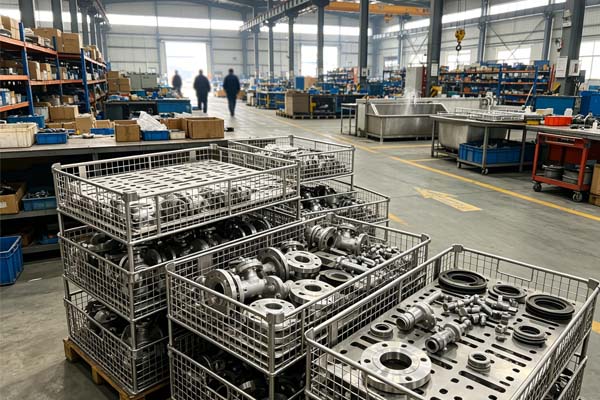
For a quality engineer choosing clean parts handling baskets, an oily housing at assembly is a warning. A housing passes the cleaning exit inspection, then arrives at assembly with an oily contact patch or loose chips. Returning it to the cleaning machine may restore the part, but the next batch still travels through the same handling route.
Choose dedicated clean parts handling baskets when dirty returns cannot reliably be cleaned and released before reuse. A shared fleet remains reasonable when its cleaning loop removes the relevant contamination and protects the basket until loading. Dedicated baskets cost space and inventory; shared baskets consume cleaning capacity and require a dependable release step.
Consider machined housings moving from a cleaning exit to a trolley, an intermediate rack and an assembly bench. This is an illustrative route, not a reported AUKE project. The basket holds the housings together, provides lifting and stacking interfaces, and exposes them to every surface that touches its interior.
Oil remaining on an incoming basket can transfer at a support wire; chips lodged near a rim can fall into the next load. A clean basket can also acquire contamination from dirty gloves, a trolley deck or the underside of another basket. Changing the basket alone will not remove those sources.
This discussion starts with parts that meet the agreed requirement at the cleaning exit. Scratches, inadequate initial cleaning and cleanroom classification are separate questions. A basket being easy to wash does not prove that parts remain clean during transfer.
Keep one line for each transfer: location | part-contact surface | basket exterior contact | oil or chips observed | elapsed time | sample reference. An unknown entry should stay unknown until observed.
At the cleaning exit, establish the part condition before it touches the receiving basket.
At each transfer, note gloves, supports, covers and stacking surfaces that could carry oil or chips.
At assembly, compare the contamination location with the recorded contacts and locate the first change.
Photographs can locate a suspected transfer point. They cannot establish a particle limit or identify an invisible oil film.
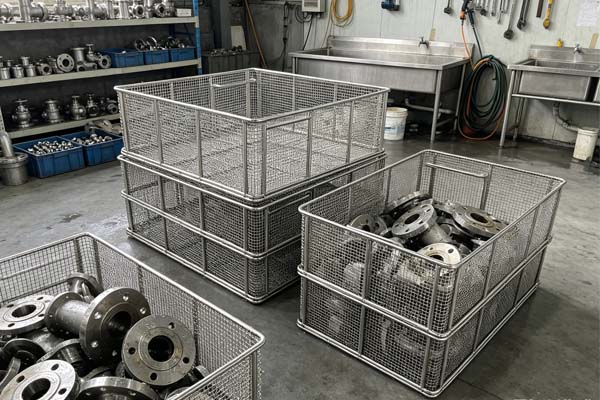
The loaded and stacked baskets show surfaces to include in a contact map; this catalog scene does not establish a clean zone or a measured contamination level.
If contamination first appears after loading, compare the usual receiving basket with a separately cleaned basket whose release condition is documented. Keep the housing type, exit condition, handling method and transfer time comparable. The customer quality team should choose sampling appropriate to the actual requirement, with blanks and handling controls where the method requires them.
A reduction with the replacement basket supports investigating the original contact surfaces or its return route. If both groups acquire similar contamination at the next station, inspect that shared station before buying a dedicated fleet. Matching particle appearance is a clue, not proof of a common source.
Oil films and chips need different assessment methods. A particle count does not establish freedom from oil, while a visual wipe cannot prove compliance with a specified particle limit. Agree the method and sampling locations before comparing baskets.
A dedicated clean basket should return to a defined clean-side holding position, not to the incoming machining queue. It still needs a cleaning schedule and a response to accidental dirty-side contact. A label identifies intended use; it does not remove contamination.
For a shared fleet, the return route must include basket cleaning, drying where required, protected storage and release before clean parts are loaded. The process owner must demonstrate removal of representative oil and chips, including sheltered contact areas. A wash program validated for the parts is not automatically validated for an empty basket.
Allow enough baskets for the cleaning and return time, including baskets held after a failed release. Otherwise a shortage can encourage reuse before the loop is complete. If this cannot be maintained in normal production, a dedicated clean-side fleet is the more defensible choice.
Send us a route photograph and a short description of where contamination first appears. We could use them to discuss whether a separate basket, a changed stacking interface or better access for basket cleaning deserves a sample comparison. The process trial would remain with your team or an agreed testing provider.
For a proposed AUKE basket, we would distinguish surfaces touching housings from feet and stacking rims touching equipment. Avoiding an inaccessible folded overlap may help basket cleaning, but replacing it with an open detail must still retain the parts and carry the load. Material selection depends on the actual basket-cleaning chemistry and exposure, not appearance.
A cover can reduce some direct exposure during waiting, but an ordinary lid is not a dust seal. Its underside and handle can themselves carry contamination. The open sides or holes remain paths for airborne material, so a sealed enclosure requirement needs a separate specification.

The holes in this cover remain open to the surroundings. Select it for an agreed handling purpose, not as evidence of dust-tight protection.
Trial the proposed basket through loading, waiting, stacking and assembly, including the empty return. Compare part cleanliness at the exit and assembly using the agreed method over representative cycles. Neither a clean sample basket nor one successful transfer proves the routine is stable.
The approved drawing should identify part-contact areas, stacking clearances, joint details and material specification. Agree finished dimensions after forming and welding, fixture identification and batch inspection records for the features that keep dirty exterior surfaces away from parts. If a later batch changes those contacts, hold it, record the deviation, correct the fabrication cause and repeat the relevant dimensional and transfer tests.
No. A shared fleet is viable when basket cleaning and release work reliably under the actual return conditions.
Not by itself. Contact transfer and open paths remain, and the cover must enter the same cleanliness routine.
No. Identification helps prevent mix-ups but provides no evidence that oil or chips have been removed.
No. Route photos and the first observed contamination point can narrow the design question; dimensions and trials follow.
Our custom wire baskets provide a starting point for handling and cover options. Browse Custom Metal Baskets before defining the clean-side arrangement.
Email one route photo and the observed oil or chip location. We can discuss which basket contact or return arrangement needs attention; drawings and a process trial would be needed before confirming a design.
Email AUKE Your Route PhotoBy AUKE Engineering Team


