Views: 12 Author: Lucian Publish Time: 2026-11-20 Origin: Site


AUKE / CLEANING BASKET SELECTION
The same opening size can hide very different basket constructions. Compare the open area, the way your parts are loaded and the support beneath them.
Which basket makes more sense for your parts: wire mesh or perforated sheet? Both are used for industrial cleaning. The choice depends on what goes into the basket, how it is loaded and what happens during the cleaning cycle.
At AUKE, we work with both constructions. A batch of small loose components needs openings that keep the parts inside while allowing cleaning liquid through. A few heavier components need support where their weight rests. Parts with surfaces that must not touch each other need a suitable internal arrangement, whichever basket construction is used.
The basket body is one part of that design. We consider it together with the load, the contact points and the space available in your cleaning machine.
Two baskets described as having "2 mm mesh openings" can have quite different mesh surfaces. The missing detail is wire diameter: it determines how much metal sits between those openings.
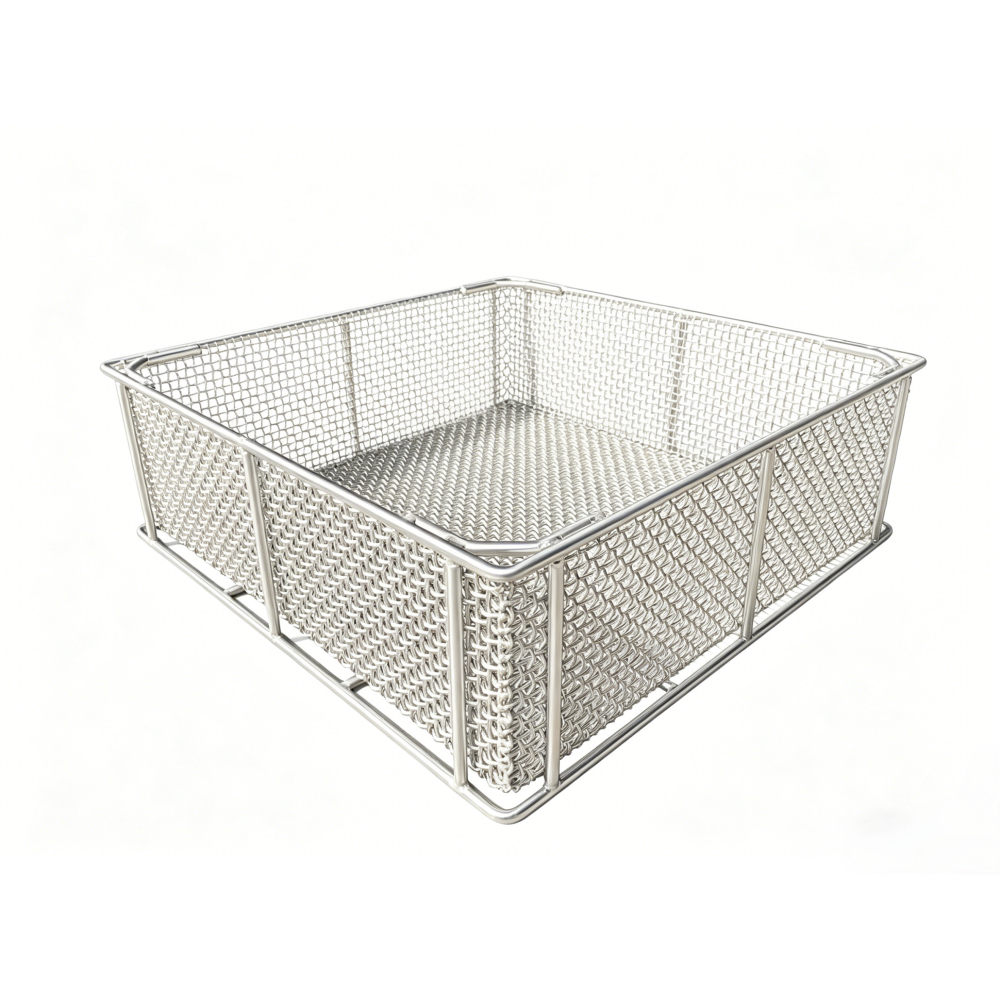
2 mm clear opening with 0.5 mm wire.
2 mm clear opening with 1.0 mm wire; rounded from 44.4%.
Calculated square-mesh examples, excluding frames. Not specifications of the pictured basket or cleaning-test results.
Both have the same nominal opening, but the second has considerably more metal across its surface. Once the opening is small enough to retain the components, choosing thicker wire changes the construction without making that opening any smaller. It may be appropriate for the load, but it also reduces the open area available for liquid passage.
That is why a wire cleaning basket should be considered as a mesh-and-frame assembly. The mesh retains the parts, while wire diameter, supports and frame construction together determine how the load is carried.
When comparing it with a perforated basket, hole size alone is not a complete comparison. Open-area percentage and the supporting structure belong alongside it. More open area does not automatically mean a cleaner part, but it reveals a difference that the label "2 mm opening" leaves out.
A perforated basket can have small holes without being particularly open. The distance between those holes determines how much of the sheet remains solid. This is the detail a description such as "2 mm perforations" leaves out.
3 mm centre-to-centre spacing; rounded from 40.3%.
4 mm centre-to-centre spacing; rounded from 22.7%.
Calculated examples for round holes on 60-degree staggered centres. Percentages exclude solid borders and do not describe the pictured basket.
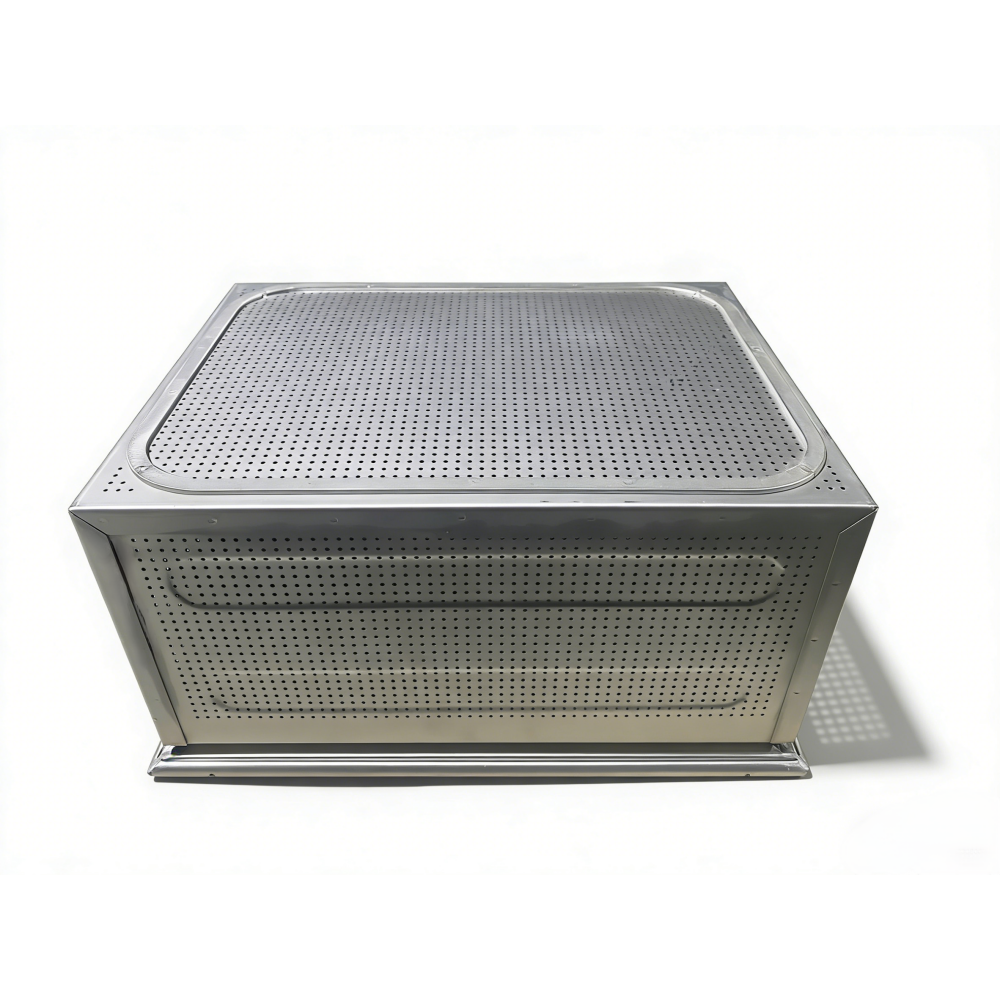
Both sheets have the same hole diameter. Yet increasing the spacing by just 1 mm leaves substantially less open area. If the hole diameter already suits the parts, changing the spacing offers a way to adjust openness without making the individual holes larger.
That choice also changes the amount of metal remaining between holes. Sheet thickness, borders and reinforcement therefore belong in the same discussion.
Increasing sheet thickness does not increase the open-area percentage when the hole pattern stays the same. It changes the depth of each opening, the basket's weight and its structural behaviour.
For a perforated cleaning basket, the useful specification is the combination: hole diameter for part retention, spacing for openness, and sheet thickness with suitable supports for the load. This makes a perforated design worth considering when those features need to be coordinated in a formed sheet-metal body.
An open-area figure describes the basket surface before parts cover it. A higher percentage does not necessarily give cleaning liquid better access to the surfaces that matter once the load is in place.
Consider a batch of flat components. If they lie tightly against one another, changing from perforated sheet to wire mesh does not separate those contact surfaces. The more useful change may be the loading arrangement: spacing the parts, supporting them on edge or dividing the batch into smaller groups, where the process permits.
For heavier components, a few parts resting on narrow feet concentrate their weight differently from many small parts spread across the floor. The position of the supports beneath the load can matter as much as the choice between mesh and perforated sheet.
At AUKE, we can discuss either construction around the same parts and batch quantity. Comparing both with the intended load makes the choice more useful than comparing two empty baskets of similar size.
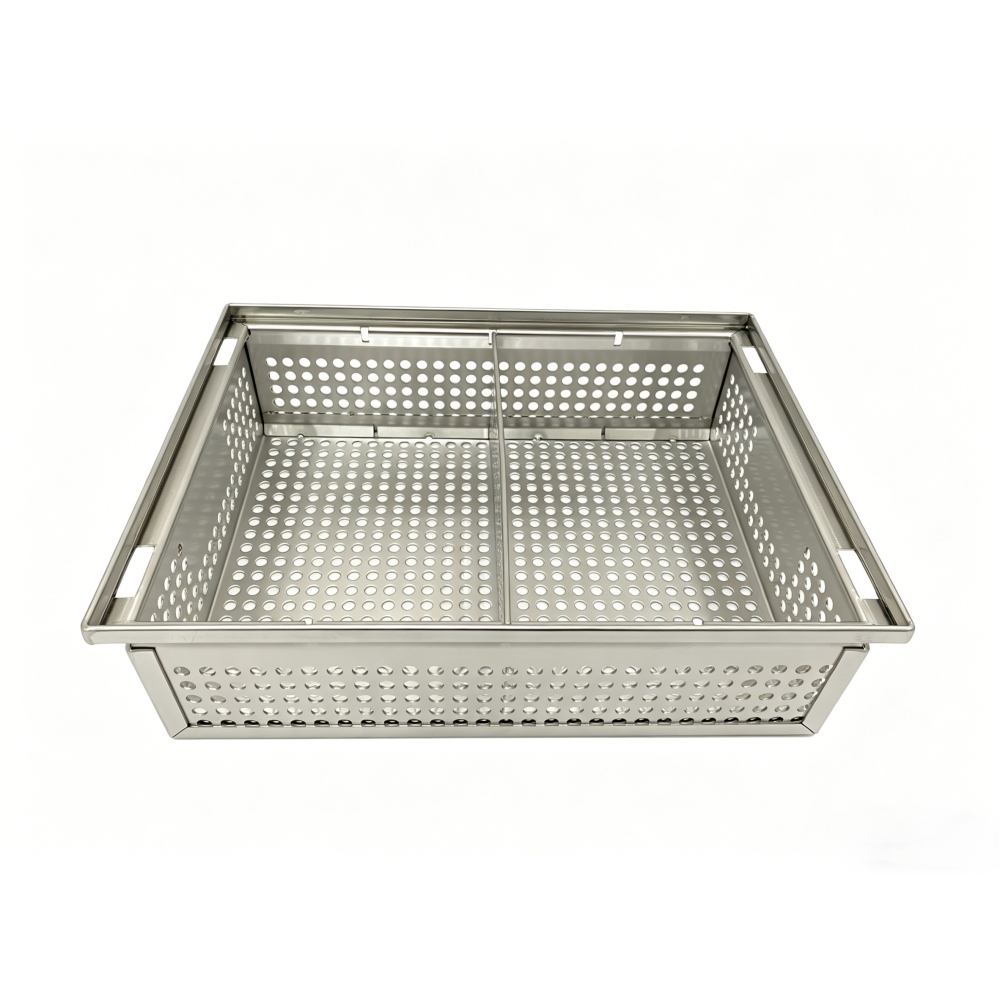
The central divider in this AUKE tray creates two loading compartments. It separates groups of parts, but does not keep every part within a compartment apart. Where individual surfaces must remain exposed, dedicated supports or individual positions are the more relevant design choice.
A useful proposal should show what each construction gives you with the same parts, batch quantity and machine dimensions. Otherwise, a lighter basket or a larger open-area figure may simply reflect a different specification.
Actual opening dimensions and shape, including corner gaps and lid-edge gaps where fitted.
Open area, solid borders, supports and the way the loaded parts cover the openings.
Wire diameter or sheet thickness, reinforcement beneath the load and machine support locations.
Basket weight plus part weight, usable grips and compatibility with transfer equipment.
For an AUKE proposal, part drawings or photographs and the normal batch quantity provide a starting point. Together with the cleaning method and equipment dimensions, they help define a configuration that retains the parts, supports the load and leaves the access your process needs.
Not necessarily. Round and square openings have different shapes, even when both are described as 2 mm. Thin or irregular parts may pass through one shape or orientation but not another. The comparison needs the actual part shape and opening dimensions, including tolerances.
No. A reinforced wire mesh basket and a lightly supported perforated basket are not equivalent structures. Load capacity depends on material, wire diameter or sheet thickness, panel dimensions, connections and the supporting frame.
More open area provides more passage through the basket surface, but it does not separate touching parts or expose a surface resting against a support. Loading arrangement and cleaning method still determine access to the required surfaces.
Yes. Part drawings or clear photographs, the usual quantity or weight per batch and the cleaning-machine requirements can start the discussion. These help us identify a suitable opening, loading arrangement and supporting structure.
You do not need to decide between wire mesh and perforated sheet before speaking with us. Your parts, batch size and cleaning equipment give us a better starting point than a basket type alone.
A part drawing or clear photograph can begin the discussion. AUKE can then explore the opening size, supports and internal layout with you, so the proposed construction has a clear reason behind it: how it holds your parts and fits the way you clean them.
Discuss Your Cleaning BasketBy AUKE