


Views: 115 Author: Lucian Publish Time: 2026-10-30 Origin: Site


AUKE / HYDROCARBON CLEANING
Support the part. Limit unwanted movement. Replace a worn contact piece without automatically replacing the tray.
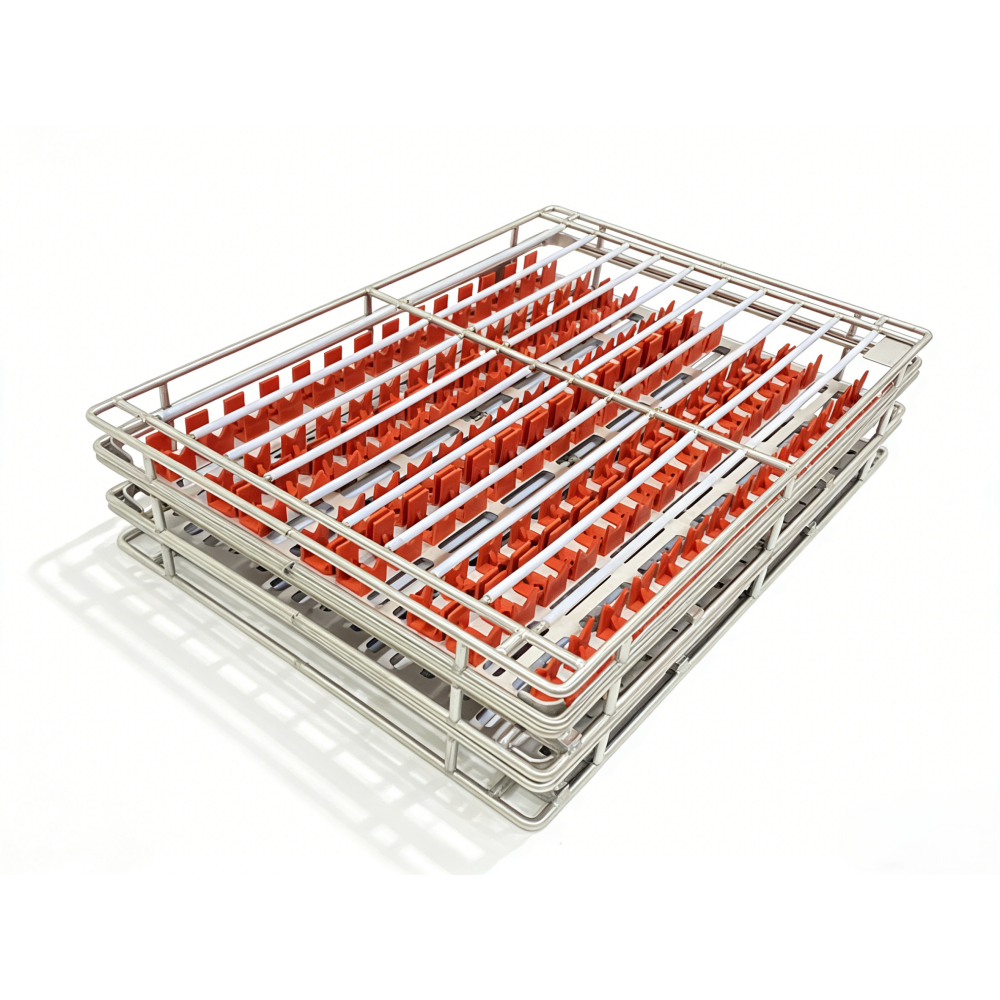
A hydrocarbon cleaning basket needs to do more than fit inside the machine. It must support the parts without exposing vulnerable surfaces to unnecessary contact, while leaving room for the cleaning fluid to reach them.
In this AUKE design, the basket consists of a tray and a matching hold-down lid. Orange plastic supports carry the parts from below, while the lid helps keep them seated. Teflon sleeves cover selected steel rods where bare-metal contact is unwanted. The support positions and lid contact points are chosen around the parts being cleaned.
We have also made the plastic supports individually replaceable. If a support wears out while the tray and its mounting location remain sound, it can be removed and replaced on its own. The design addresses both how the parts are held during cleaning and what needs replacing later.
PART SUPPORT
The orange plastic supports give each part a defined place to rest. Their positions should follow the component’s shape and the surfaces that can carry its weight, rather than simply divide the tray into evenly spaced rows. A thin edge or a finished face may need to remain clear, even when it would be a convenient place to add a support.
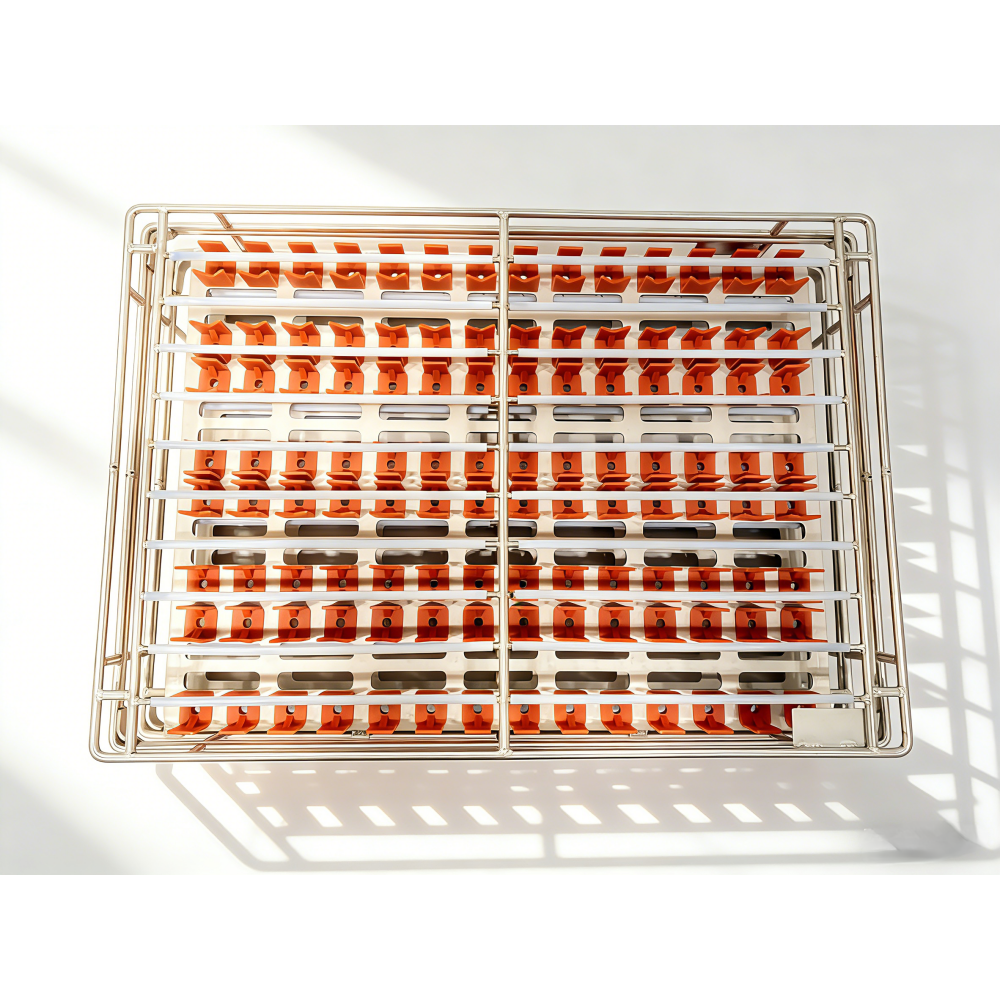
Rows of orange supports provide contact locations within the tray. The appropriate layout depends on the shape and permitted contact surfaces of the loaded parts.
The hold-down lid works with these supports to limit movement. Its contact points need to be positioned so that the force is carried through a supported section of the part. Pressing on an unsupported section could bend the component or leave a mark; a tighter lid would not solve that problem.
For a custom AUKE tray, we can discuss the lower support positions and lid contacts together. The aim is to keep the part seated without pressing against surfaces that need protection or blocking areas that need cleaning. This is where a part-specific layout offers more than a basket chosen by outside dimensions alone.
CONTACT PROTECTION
The steel rods support the tray structure or form part of the lid. Where those rods may touch a component, AUKE fits Teflon sleeves over them so the part rests against the sleeve rather than exposed metal. These are separate sleeves fitted around the rods, not a coating applied to the finished basket.
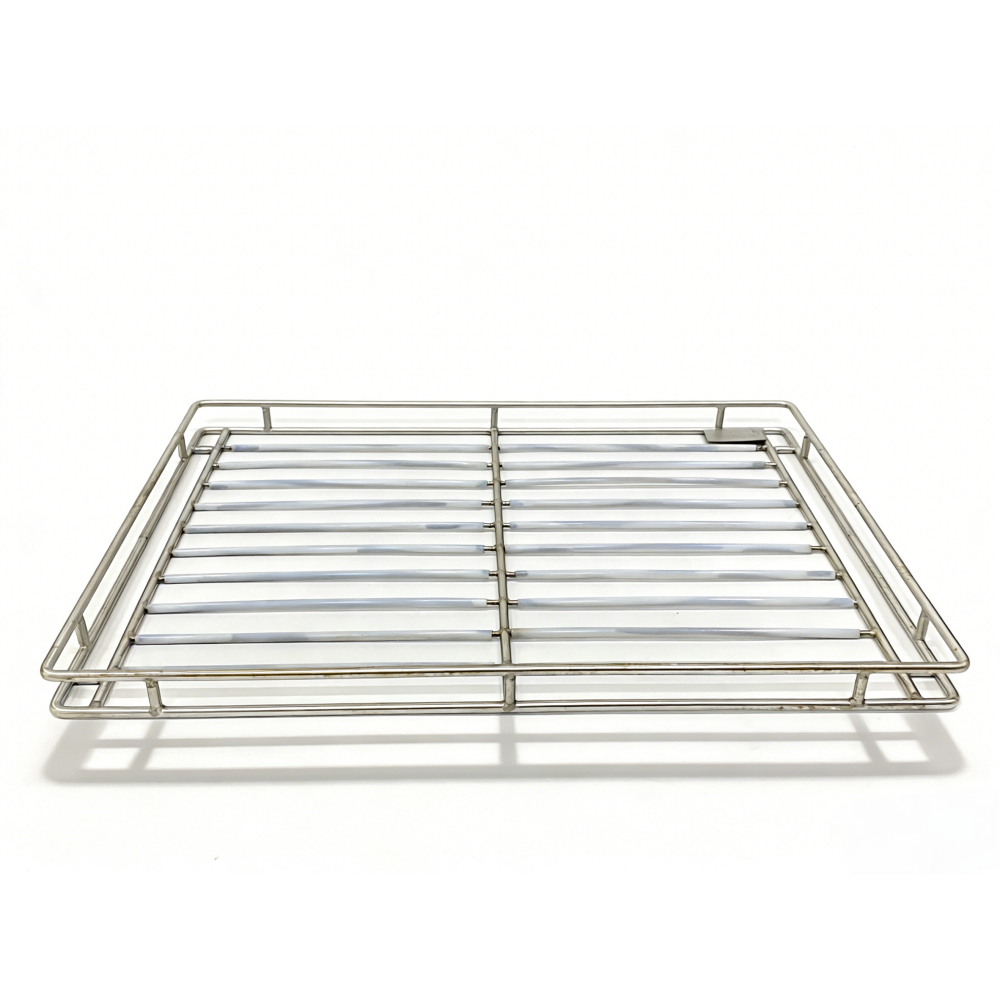
Sleeves cover the parallel rods, separating those contact surfaces from exposed steel.
This allows us to retain the steel structure while changing the contact surface at selected locations. For parts with surfaces prone to marking, the sleeve provides a barrier against direct metal contact. Its position matters as much as its material: a covered rod pressing against the wrong area can still place unwanted force on the part.
The sleeves do not hold the parts in place by themselves. That remains the job of the support layout and matching lid. We consider these features together so that contact protection does not come at the expense of secure positioning or access for the cleaning fluid.
LOCAL REPLACEMENT
A worn plastic support does not necessarily mean the metal tray has reached the end of its service life. When the frame and mounting location are still in good condition, replacing the complete tray would also mean replacing parts that remain usable.
The orange supports in this AUKE design can be removed individually by rotating them. A worn or damaged piece can therefore be replaced on its own, without cutting out a welded support or replacing the tray. This gives customers a practical way to maintain the contact points while retaining the main structure.
The replacement needs to match the specified shape, height and material. A support that fits the mounting location but holds the part higher or lower can change how the lid contacts it. Keeping those details consistent helps preserve the intended fit after replacement.
Individual replacement is useful when wear is confined to the plastic piece. If the mounting location is damaged or the tray has distorted, changing the support alone will not restore the assembly. The benefit is being able to replace only what needs replacing, rather than treating every worn contact point as a reason to buy a new tray.
THE APPLICATION DESCRIBED
Hydrocarbon cleaning: approximately 60°C
Drying: approximately 100°C
The application described here uses hydrocarbon cleaning at around 60°C, followed by drying at around 100°C. The tray stays with the parts through both stages, so choosing its contact materials around the cleaning temperature alone would overlook the hotter part of the cycle.
The Teflon sleeves and orange plastic supports need to be considered separately. Suitability of the sleeve does not establish suitability of the plastic support: each material must suit the cleaning medium, exposure time and temperature, while performing its job under load. These operating temperatures describe this application, not a general rating for every AUKE tray.
For a custom tray, we need to understand the drying stage as well as the cleaning bath. That helps us discuss a material and support arrangement for the complete cycle, rather than select a contact material simply because it protects the part at room temperature.
A tray may fit inside the cleaning chamber but still be unsuitable once the parts are loaded and the lid is closed. The complete assembly needs enough clearance, and its frame must meet the machine’s support and handling points.
For a custom AUKE tray, these equipment interfaces need to be considered alongside the internal layout. The machine determines where the tray is supported; the component determines where the plastic supports and lid may touch it. Simply reducing the tray’s outside dimensions could leave less room between parts or put a contact point in the wrong place.
We can discuss both sets of requirements together: the space and interfaces available in your machine, and the position each part needs to maintain during cleaning. The aim is a tray that fits into the existing process without forcing you to compromise on how the parts are supported.
Explore AUKE’s custom wire basket configurations as a starting point for discussing your application.
COMMON QUESTIONS
The tray-and-lid concept can be adapted, but one support layout should not be assumed to suit every part. A different shape may need different support positions or lid contacts. Parts with similar outside dimensions can still have different surfaces that must remain untouched.
The sleeves separate selected contact surfaces from bare steel. They are not a substitute for locating the part correctly. Movement is controlled by the support arrangement and the matching lid, rather than by relying on friction from the sleeve.
Look for damage or wear that changes how the part rests, or prevents the support from seating securely. A loose fit may also indicate damage at the mounting location, so replacing the plastic piece is not always enough. No fixed replacement interval is specified here; the appropriate interval depends on the material, load and cleaning cycle.
Start with a photo of the part or your current tray, and tell us what you want to improve. Include the cleaning medium and the cleaning and drying temperatures if available. You do not need a complete drawing package for the first discussion; dimensions and equipment details can follow as the requirements become clearer.
Whether you are specifying a new tray or replacing one that marks parts or has worn supports, tell us what the tray needs to do. A part photo, the surfaces that must be protected and a brief description of the cleaning cycle give us a useful starting point.
AUKE can discuss where the part should rest, how the lid should hold it and where replaceable supports would make maintenance easier. We can then work through the dimensions, equipment interfaces and material requirements needed to develop the design.
Email AUKE About Your Cleaning TrayBy AUKE Engineering Team


